


The Crisis of Exile
In his Old Testament Story John Tullock paints a grim picture of the aftermath following the Babylonian attack:
"The land lay in ruins. Cities that once had been alive with people now were blackened piles of rubble. Fields that once had produced abundant crops of life-sustaining foods now lay idle, overgrown with weeds. Jerusalem, the once proud capital city of David and Solomon, was wrecked. Its houses, from the hovels of the poor to the palaces of its kings, were burned to the ground; its massive walls were filled with gaping holes; and the Temple, the building that popular religion was sure would be the magic charm to protect the city, was just another heap of rubble. And the people who had given life to the city were gone. Many were dead in the city's ruins; others were exiles in neighboring lands. Those of the upper echelons of society who had survived, for the most part, had been carried to Babylon as prisoners of war. Most of those left behind were poor farmers and shepherds, men incapable of leading any kind of revolt against the powerful armies of Babylon."
The Exile Experience
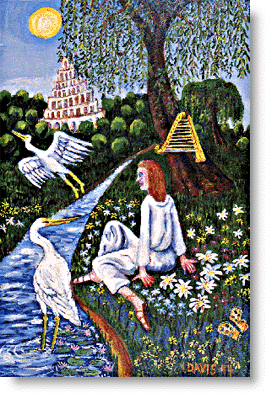 The anguish of the Babylonian exile is remembered in Psalm 137. Read the psalm below and consider the emotional state of the psalm's persona.
By the waters of Babylon,
there we sat down and wept,
when we remembered Zion.
On the willows there
we hung up our lyres.
For there our captors
required of us songs,
and our tormentors, mirth, saying,
"Sing us one of the songs of Zion!"
How shall we sing the LORD's song
in a foreign land?
If I forget you, O Jerusalem,
let my right hand forget its skill!
Let my tongue stick to the roof of my mouth,
if I do not remember you,
if I do not set Jerusalem
above my highest joy!
Remember, O LORD, against the Edomites
the day of Jerusalem,
how they said, "Lay it bare, lay it bare,
down to its foundations!"
O daughter of Babylon, doomed to be destroyed,
blessed shall he be who repays you
with what you have done to us!
Blessed shall he be who takes your little ones
and dashes them against the rock!
The Book of Lamentations
The book of Lamentations is a collection of five funeral songs (dirges) that mourn the loss of Jerusalem. The poetry of Lamentations reflects a Hebrew dirge rhythm in an acrostic format. The images in these poems are vivid, allowing the reader to be present and experience the horror of the destruction.
The five poems of Lamentations:
- Jerusalem: Disobedient, Abandoned, Ruined (Ch 1)
- The Punishment of Jerusalem: What Happened and Why (Ch 2)
- A Personal Lament: The Suffering of Life, Trusting God, and Deliverance from the Enemy (Ch 3)
- The Horrors of the Siege of Jerusalem (Ch 4)
- Plea for Restoration (Ch 5)
Changes after the Exile
For the exiles, life would never be the same. The list below briefly describes some of the changes and revived interests brought on by the Babylonian exile.
New Name: The exiles, being primarily Judahites (i.e., from the tribe of Judah) became known as Jews.
New Lifestyle: A primarily rural people group who worked as farmers and shepherds became a primarily urban people group, making a living in the city commerce.
New Language: The Hebrew-speaking exiles adopted Aramaic, the most widely spoken language in that area at that time.
New Worship: The loss of the temple brought with it the loss of the temple sacrificial cult. The forms of worshiping the Lord had to be reconsidered.
New Emphasis on Tradition: The exile created an urgent need to preserve the story of the Lord's people.
New Emphasis on Theology: The exiles became devout monotheists, strictly adhering to worship of the Lord alone.
